
When a Quaker industrialist preserved one of Islam’s most sacred memories amid the bustle of a chocolate empire.
There is a strange yet beautiful story about how civilization is often quietly shaped by unexpected hands. In the early 20th century, while the name Cadbury was firmly associated with the chocolate empire of Birmingham and the ideal factory estate of Bournville, one of the founder’s grandsons, Edward Cadbury (1873–1948), was contemplating something far more enduring than sugar and cocoa beans.

He was a Quaker — a Christian denomination that values simplicity, peace, and equality. Inspired by the strong philanthropic spirit within the Quaker tradition, Edward did not merely want to produce chocolate that melted on the tongue; he also wanted to create “chocolate for the soul”: a grand center for theological studies in Birmingham.

But history had other plans. His aspiration to elevate Birmingham as a center of religious scholarship ultimately became one of the most important acts of preservation for Islamic civilization — an act that, a century later, would astonish the world.

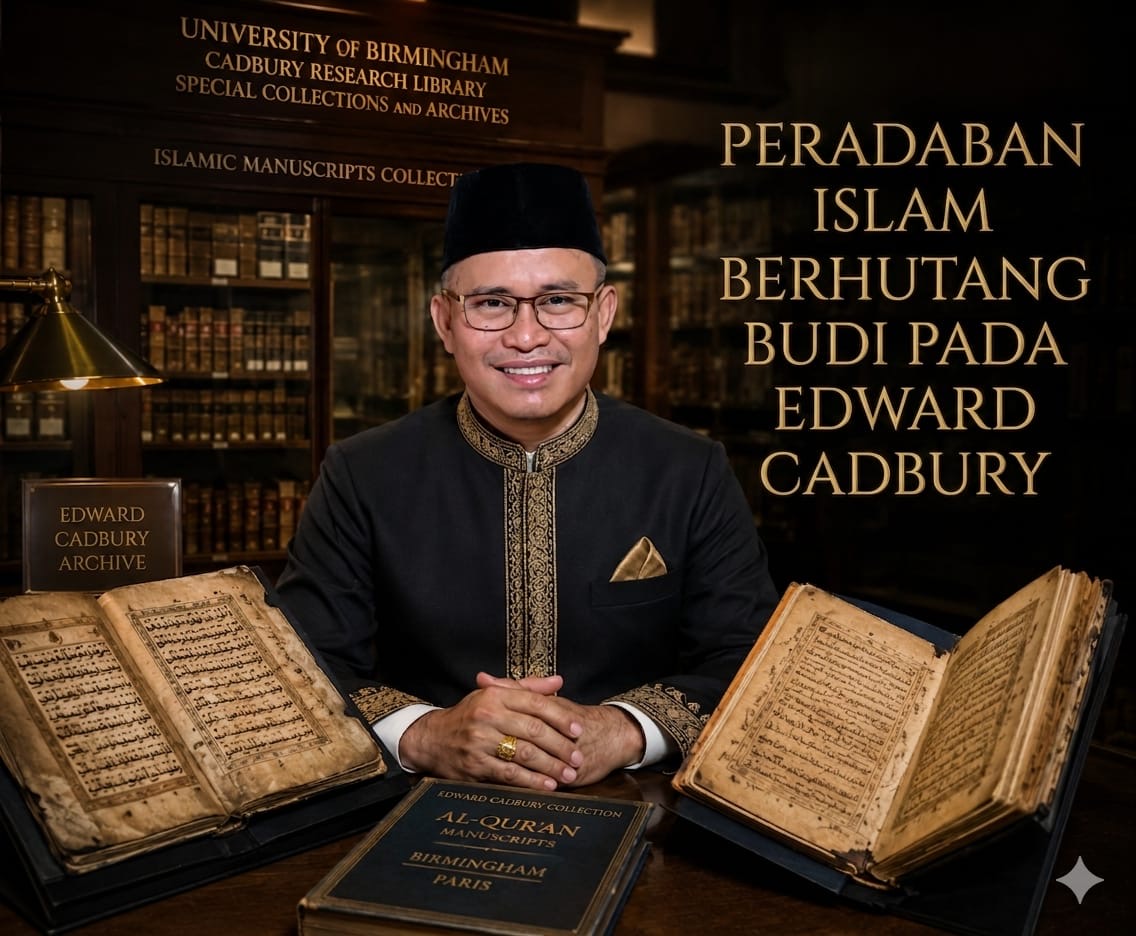
In the 1920s, Edward Cadbury financed a series of expeditions to the Middle East. The man leading these missions was Alphonse Mingana (1878–1937), an Iraqi-born Chaldean priest and expert in Eastern manuscripts.
With Cadbury’s funding, Mingana traveled across the Middle East in 1924, 1925, and 1929, collecting more than 3,000 documents in over 20 languages — including Arabic, Syriac, Ethiopic, Georgian, Hebrew, and many others.

Among the piles of parchment brought back to Birmingham was a small artifact catalogued as “Islamic Arabic 1572a.” It did not appear extraordinary at first glance.
Just two parchment leaves (made from sheep or goat skin), written in carbon-based ink in the Hijazi script — one of the earliest and most primitive forms of Arabic calligraphy.
For nearly a century, the manuscript sat quietly on the shelves of the Mingana Collection, overlooked and largely forgotten, assumed to be an ordinary Qur’anic fragment from the 8th or 9th century.
But in 2015, a PhD researcher named Alba Fedeli examined it more closely through paleographic analysis — the study of ancient writing — and the world was shaken.
Fedeli realized the script was not from the 8th century at all. She suspected it dated back to the very first century of Islam. To verify this, the University of Birmingham sent samples of the parchment to the Radiocarbon Accelerator Unit at the University of Oxford.
The results, released in July 2015, were astonishing. With a probability of 95.4%, the parchment was dated between 568 and 645 CE. Historically speaking, this means the manuscript could have been written within just 15 to 20 years after the death of Prophet Muhammad ﷺ in 632 CE.
Imagine holding a parchment whose animal skin came from a creature still alive when General Khalid ibn al-Walid was fighting battles, or when Umar ibn al-Khattab was leading the Muslim community.
This was not merely a copy; it was likely one of the oldest Qur’anic manuscripts in the world — possibly written during the caliphates of Uthman or Ali.
The BBC, The Guardian, and The New York Times all reported the discovery extensively. The Muslim world was mesmerized. The two parchment leaves contain parts of Surah Maryam (Chapter 19) through Surah Taha (Chapter 20) — verses recounting the stories of Prophet Yahya (John), Maryam (Mary), and the calling of Prophet Musa (Moses).
Consider the historical irony: one of the world’s oldest Qur’an manuscripts is preserved not in Cairo, Istanbul, or Madinah, but in a climate-controlled room at the Cadbury Research Library, University of Birmingham.
Why?
Because in 1999, the Edward Cadbury Charitable Trust — established by Edward in 1945 — donated the entire Mingana Collection to the University.
Edward Cadbury also founded the Chair of Theology at the University of Birmingham in 1936, a position that still exists today. He built laboratories, paid curators, and funded Mingana’s journeys.
Without the support of a Quaker industrialist who never uttered the shahada, these parchment leaves might have ended up wrapping fish in a Syrian market or burned in the fires of revolution.
A Legacy for Civilization
Today, the Birmingham Qur’an Manuscript is regarded as a British national treasure of “international importance.” But for Muslims, it is something even more profound: a direct physical connection to the earliest generations of Islam — evidence that the Qur’anic text read today is almost identical to the one recited by the Prophet’s companions in the Arabian desert 1,400 years ago.
Islamic civilization owes a debt of gratitude to Edward Cadbury
Not a debt of wealth, but a debt of memory. Cadbury — a chocolate magnate and Quaker Christian — became, in many ways, a guardian of Islamic memory in the modern age. He purchased and preserved texts during the collapse of the Ottoman Empire and amid the turmoil of war in the East. He did so because of the Quaker spirit of interfaith understanding.
At a time when many were busy destroying symbols, Edward Cadbury built libraries. When others burned books, he collected and preserved them with dignity and respect.
When you unwrap a Cadbury chocolate bar at a convenience store today, it is hard to imagine that behind that gentle purple logo lies a spirit that once sailed to the Middle East, carried ancient parchments home, and entrusted them to the world.
Edward Cadbury demonstrated that civilization does not care who preserves it. What matters is that it is preserved.
And because of a Quaker in Bournville, the echo of the voice from the Cave of Hira can still be heard today, just as it was first revealed:
“Read in the name of your Lord who created…”
Thank you, Mr. Cadbury.
No chocolate is sweeter than virtue.
Idea shared by: Hery Arianto
(Social & Media Observer)